
What is missing in the BJP's armour is dominance over 50 percent of the electorate: Women. And this is a gamble Modi-Shah have indicated that they are willing to take, explains Saisuresh Sivaswamy.

The case pertains to the Union government's plea for vacation of the stay on any kind of religious activity in the 67 acres of acquired land around the disputed structure.

Haryana government suspends jail officials after a terror accused was murdered inside Neemka Jail in Faridabad. The victim, Abdul Rehman, was allegedly involved in a conspiracy to attack the Ram temple in Ayodhya.
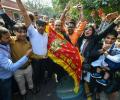
During the hearing, the 92-year-old senior lawyer had told the apex court that it must do 'full and complete justice' in all matters before it and that his last wish before he died was to finish the case.

The Supreme Court has rejected a petition seeking to prevent the construction of mosques named after Mughal emperor Babur.
Charges framed against Advani, 7 more in Ayodhya demolition
A court in Mumbai acquitted a 53-year-old man in a 1993 riots case, citing the prosecution's failure to prove his participation in the violence that followed the demolition of the Babri Masjid.

The Akhara counsel told the apex court that their suit was basically for belongings, possession and management rights.

Tensions between Shankaracharya Swami Avimukteshwaranand Saraswati and the Uttar Pradesh government led by Chief Minister Yogi Adityanath have drawn national attention in recent months.
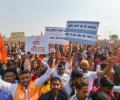
The SC also said that if parties to the case want to amicably resolve the matter through mediation, they can still go ahead with it.
The Supreme Court on Tuesday refused to interfere with the criminal proceedings in cases relating to the demolition of disputed structure at Ayodhya in which the trial involving senior Bharatiya Janata Party leader L K Advani and seven others VVIPs were segregated from others.
As the case came up for hearing before the Special Judicial Magistrate V K Singh, the counsels for CBI and the defence informed the court that they would prefer to stay away from judicial work as a mark of solidarity with the local lawyers.
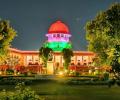
The Supreme Court has agreed to list for final hearing the pleas challenging the validity of certain provisions of the Places of Worship (Special Provisions) Act, 1991.

An investigation has been launched into the authenticity of the disability certificate of Prashant Kumar Singh, who resigned as GST Deputy Commissioner in protest against remarks made against Chief Minister Yogi Adityanath. The probe was initiated following a complaint filed in 2021.
The Kshatriya Mahasabha had sought to be made a party to the Ayodhya title case.
The Lucknow bench of the Allahabad high court on Friday has refused to defer its verdict on the title suit of the disputed site at Ayodhya.
While Hindus claimed the land to be the site of the birthplace of their most revered Lord Ram, Muslims asserted their right over the same as the site of a 16th century mosque claimed to have been built by the first Mughal emperor Babur in the ancient town of Ayodhya, about 120 km from Lucknow.

The apex court had on July 11 sought a report on the mediation process and said that a day-to-day hearing might commence from July 25 if the court decides to conclude the mediation proceedings.
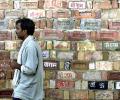
The counsel stated that from the pillar bases, artefacts, circular shrine, intersecting brickbat walls found in excavation, an inference can be drawn that the massive structure was a temple and not any Islamic structure.
The judgment in the matter is to be pronounced by November 17, the day the CJI will retire.
The Hindu Mahasabha, one of the parties in the Ayodhya title suits, has filed an objection relating to the judgement of the Allahabad high court on the Ram Janmabhoomi-Babri Masjid dispute.
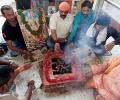
The eagerness of locals and tourists in Ayodhya seems to have peaked with Chief Justice of India Ranjan Gogoi reiterating that Wednesday will be the last day of hearings in the Ram Mandir-Babri Masjid land dispute case.
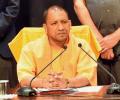
"We are developing Ayodhya in this Kalyug as Ayodhya was in Treta Yug," he said, referring to mythical times.

Mark Tully, the renowned journalist, author, and Indophile, has passed away at the age of 90. He spent a lifetime in India as a journalist, mingling with its people and telling their stories.
The apex court had last year disallowed Swamy from intervening in the Ayodhya land dispute case.
The central government said, "It was an act of national shame, what was demolished was not merely an ancient structure but the faith of the minorities in the sense of justice and fair play of the majority.

'The burden of proof is on Muslim parties to show that this finding, that the mosque was built on land held sacred by Hindus, is wrong'
The apex court requested the committee to inform it by August 1 about the outcome of the proceedings held till July 31.
The counsel appearing for both the Hindu and Muslim parties expressed confidence over the ongoing mediation proceedings and said they are fully cooperating with the process.
The 1994 judgment envisaged status quo only on the 2.77 acres of disputed area, the Centre pleaded.
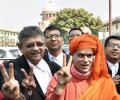
The bench directed that the mediation will be held at Faizabad in Uttar Pradesh and the process should start within a week from Friday.
It was a textbook blind murder with scarce clues, no witnesses and no apparent motive.
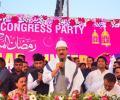
Ajit Pawar became a ray of hope for Muslims, the only man in power who could resolve their grievances.
The Central Bureau of Investigation has told the Supreme Court that the trial of Bharatiya Janata Party leader L K Advani in the Ayodhya demolition case has to be carried on without dropping the conspiracy charge against him as the razing down of the medieval monument was part of a "single larger conspiracy". The agency, in its recent affidavit, opposed the separation of trial of eight accused leaders -- Advani, Murli Manohar Joshi, Uma Bharti, Vinay Katiyar etc.
The Lucknow bench of the Allahabad High court rejected an appeal for an out-of-court-settlement of the Ayodhya. The Nirmohi Akhada had sought a 10 day period to attempt to reach an out-of-court settlement. The court rejected the Akhada's plea and also fined petitioner Ramesh Chandra Tripathi Rs 10 lakh. The court declared that the judgement on the Ayodhya title suit would be pronounced on September 24, as was originally declared.
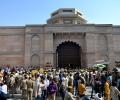
In an unusual coincidence, the two judges of a Supreme Court bench hearing a plea against the survey of the Gyanvapi-Shringar Gauri complex in Varanasi have had an association with a similar kind of dispute relating to the Ram Janmabhoomi-Babri masjid issue as well.
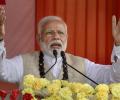
Prime Minister Narendra Modi on Sunday recalled how the government, political parties and the civil society prevented attempts to create fissures when the 2010 Allahabad high court ruling on the disputed land in Ayodhya was to be delivered.

The ASI, which had found artefacts, idols, pillars and other remains, stated in its report about the existence of a massive structure beneath the 'alleged Babri Masjid'.

Asserting that he prays regularly, the CJI said, "Believe me, if you have faith, God will always find a way."

As a storm brews online over a child's conduct on Kaun Banega Crorepati, Team India cricketer Varun Chakaravarthy has urged restraint and empathy.
